InfoSAWIT, NUSA DUA – Investigations into land fires in oil palm plantation areas must be conducted carefully, with factual verification and due legal process serving as the basis for determining responsibility. The Indonesian Palm Oil Association (GAPKI) argues that companies should not be held liable solely because a fire occurs within or near their concession areas. Authorities must also examine the cause, sequence of events, and measures taken to contain the fire.
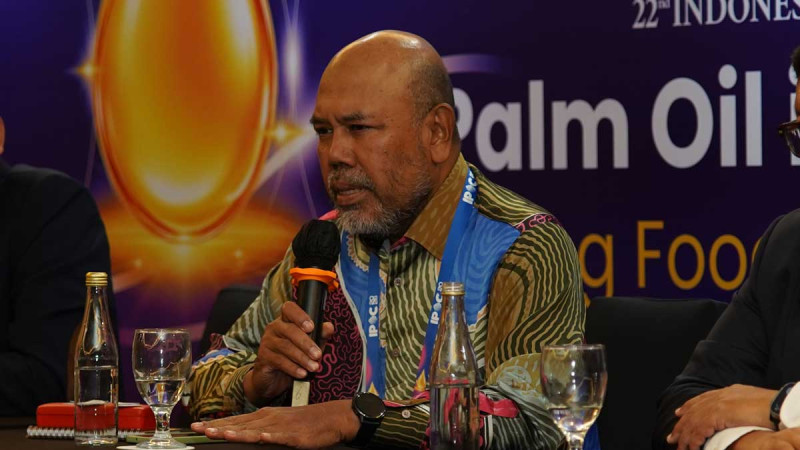
The position was outlined by Joko Supriyono, a member of GAPKI’s Advisory Board, during the 22nd Indonesian Palm Oil Conference and 2027 Price Outlook (IPOC 2026), attended by InfoSAWIT on Friday (13 November 2026) in Nusa Dua, Bali.
Joko highlighted the challenges faced by plantation companies in dealing with fires across various regions, including incidents occurring both inside and around plantation concessions. Controlling fires can be particularly difficult when flames emerge in areas that are difficult to access or spread rapidly across surrounding land.
He stressed that proper verification is essential to establish where a fire originated, how it developed, and whether negligence on the part of a plantation company was involved. Any sanctions, including the revocation of business permits, should therefore be based on clear evidence and a transparent legal process.
Fire Records Essential to Establishing Responsibility
Joko also emphasized the importance of maintaining comprehensive documentation whenever a fire occurs. Such records can help establish the chronology of an incident and demonstrate the actions taken by a company to prevent and control its spread.
The documentation should include the initial location of the fire, the time it was first detected, its duration, the direction and extent of its spread, as well as the firefighting measures undertaken.
Comprehensive records are particularly important because the origin of a fire is not always within a company's operational area. Fires may start outside a concession before spreading into plantation land.
In such circumstances, evidence of preventive measures, emergency preparedness, and firefighting efforts can provide important information for investigators assessing the responsibilities of the parties involved.
Law Enforcement Must Be Grounded in Facts
Joko further called for a clear distinction between the occurrence of a fire, evidence of negligence, and the legal responsibility of a plantation company.
Where indications of a violation are found, he said, investigation and evidence-gathering must take place before any legal decision is imposed. This approach is necessary to ensure that enforcement measures reflect the actual circumstances on the ground.
The issue remains significant for the plantation industry, as land fires can carry serious legal and administrative consequences for companies if violations are proven.
For the palm oil sector, strengthening fire prevention systems must therefore go hand in hand with sound documentation practices and readiness to undergo factual verification.
Ultimately, land fire management is not only an environmental concern for the palm oil industry, but also a matter of legal certainty and business continuity. (T2)