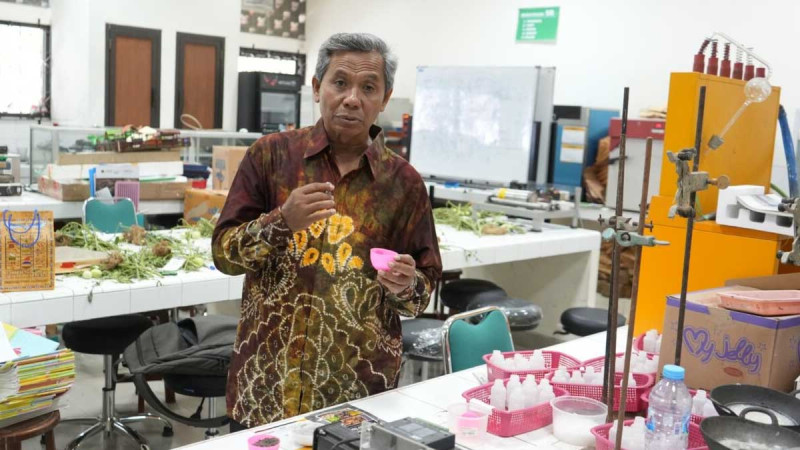
InfoSAWIT, YOGYAKARTA — Amid global challenges towards sustainable and environmentally friendly agriculture, Dr. Gatot Supangkat, a lecturer at the Faculty of Agriculture, Universitas Muhammadiyah Yogyakarta (UMY), has introduced an innovative breakthrough: a liquid organic fertilizer (POC) enriched with nano ash from palm empty fruit bunches (TKKS).
This innovation not only represents a concrete step towards achieving a healthier food system but also aligns with the principles of the Sustainable Development Goals (SDGs), particularly in preserving the environment and ensuring food security.
"Our vision is to build sustainable healthy agriculture. One of the SDGs focuses on the sustainability of the planet through safe and environmentally friendly food systems. Therefore, we chose an organic farming approach with a technological touch," Dr. Gatot stated, as reported by InfoSAWIT from UMY's official website on Monday (June 23, 2025).
The fertilizer formulation uses rabbit urine as a base material. According to Gatot, tests have shown that rabbit urine is more effective than other livestock waste. To enhance the fertilizer's performance, nano particles from TKKS ash—solid waste from the palm oil industry that has been burned at temperatures exceeding 800°C for six hours—are added.
This ash is further processed using a ball milling method, which involves mixing the ash and water in a 1:2 ratio, then rotating it with iron balls in a milling machine at 126 RPM for six hours. After being filtered and dried, the result can be used in powder or solution form.
"The processed nano-scale ash particles serve as nutrient enhancers. Due to their tiny size, nutrients like potassium can be absorbed more quickly by plants. Potassium is essential for strengthening cell walls and enhancing plant resistance to diseases," explained Gatot.
The best formulation was found in the POC composition with an additional 3 percent of nano TKKS ash. Field trials on various horticultural crops such as curly chili, pakcoy, spinach, and lettuce showed significant results: increased productivity without leaving harmful chemical residues in the soil or water.
More than just fertilizer development, Gatot emphasized that this research is UMY's contribution to building a technology-based agricultural system while still utilizing local wisdom and waste potential. "All the materials we use come from waste and production leftovers. We want to prove that even waste can give rise to smart solutions that have a broad impact on society," he stated.
Officially Patented
This innovative formulation of liquid organic fertilizer based on nano TKKS ash has officially received a patent from the Directorate General of Intellectual Property (DJKI), Ministry of Law and Human Rights of the Republic of Indonesia. This milestone is significant in recognizing scientific work that is not only academically excellent but also practically relevant to the national agricultural sector.
The innovation developed by Dr. Gatot and his team demonstrates how higher education institutions can address real societal issues—from industrial waste problems to food security challenges—through scientific and sustainability-oriented approaches. (T2)