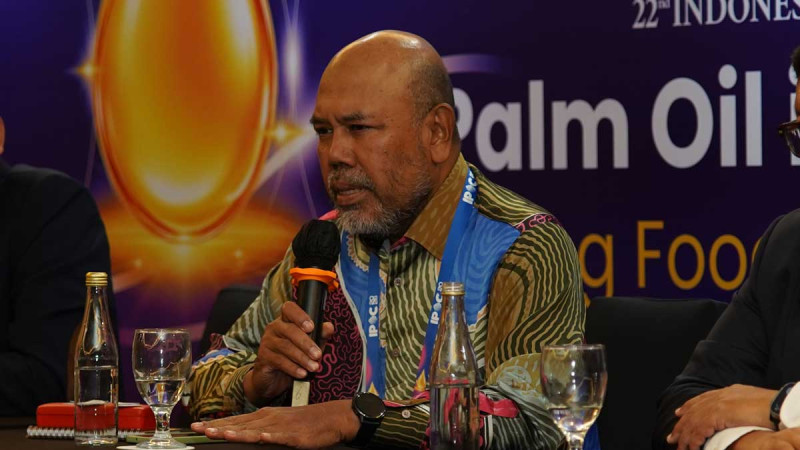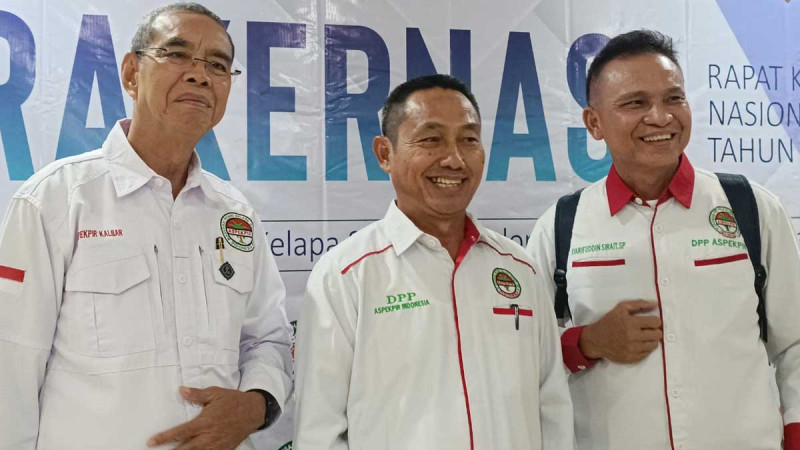
InfoSAWIT, JAKARTA - Amid the government's ongoing push for the rejuvenation of smallholder palm oil plantations, Setiyono, the Chairman of the Indonesian Smallholder Palm Oil Association (Aspekpir), revealed the realities faced on the ground. While the concept of the Smallholder Palm Oil Rejuvenation Program (PSR) is progressing well, its implementation is still encountering numerous obstacles, particularly regarding land legality.
Setiyono noted that nearly 90% of smallholder plantations participating in the PSR originate from the PIR-Trans scheme, a long-standing transmigration plantation program. "The true PSR participants are 90% Aspekpir members. However, due to the democratic climate, many other organizations have entered the fray. We respect that," Setiyono told InfoSAWIT during the Aspekpir National Working Meeting in Jakarta on Tuesday (April 29, 2025).
He also commended the government's increased support for the PSR, especially the rise in grant funds from the Palm Oil Plantation Fund Management Agency (BPDPKS) from IDR 25 million per hectare to IDR 60 million per hectare. However, many farmers are delaying their PSR applications, waiting for the grant increase to be confirmed. This has led to delays in disbursement and realization on the ground.
"Many are waiting for the grant increase, which is only a few months apart. So, those who are newly listed are just starting the process. Our national target is 180,000 hectares, from a total of 800,000 hectares of Aspekpir plantations," he explained.
Setiyono also emphasized the importance of mapping PSR areas. He likened the current situation to the chicken-and-egg dilemma—unclear whether land or seedlings should come first. "PSR must be mapped from the start. We need to identify which areas are ready, and seedlings must be prepared accordingly. We cannot have seedlings ready while the land is not, or vice versa," he stated. He added that this lack of synchronization causes confusion among agencies applying for PSR and the readiness on the ground.
In response, Normansyah Hidayat Syahruddin, Director of BPDPKS, explained that the agency remains committed to promoting the sustainability of smallholder palm oil industries. He emphasized that the PSR is one of BPDPKS's six main tasks, as mandated by Presidential Regulation No. 61 of 2015, updated through Presidential Regulation No. 66 of 2018, which is a derivative of the Plantation Law.
"Since 2016, we have disbursed around IDR 10 trillion for PSR covering more than 38,000 hectares. The grant has increased from IDR 25 million to IDR 60 million per hectare. This reflects the government's commitment," said Normansyah.
However, he acknowledged that challenges remain, particularly in the partnership-based PSR application process. Although it holds more promise, only 11% of partnership applications have passed technical verification (Rekomtek). "The main issue remains land legality. Many of our farmers are still on land that is not legally clear, such as HPH. If the land is not clean and clear, we cannot disburse funds," he asserted.
BPDPKS will also continue its support for infrastructure assistance, education, research, and promotion of sustainable palm oil. This year's infrastructure fund reaches IDR 219 billion, covering eight items such as post-harvest tools, road improvements, processing units, and ISPO certification—though the latter has seen the least utilization.
"We have never halted funding for infrastructure. Support for human resource development and scholarships continues to be provided," Normansyah added.
Now, all parties hope that the PSR application process will become smoother. Coordination between farmer organizations, local governments, and partner companies is key to achieving the target of 180,000 hectares. For Setiyono and Aspekpir, their role extends beyond advocating for their members; they aim to ensure that every palm oil tree planted reflects a rejuvenation effort that is fair, targeted, and sustainable. (T2)