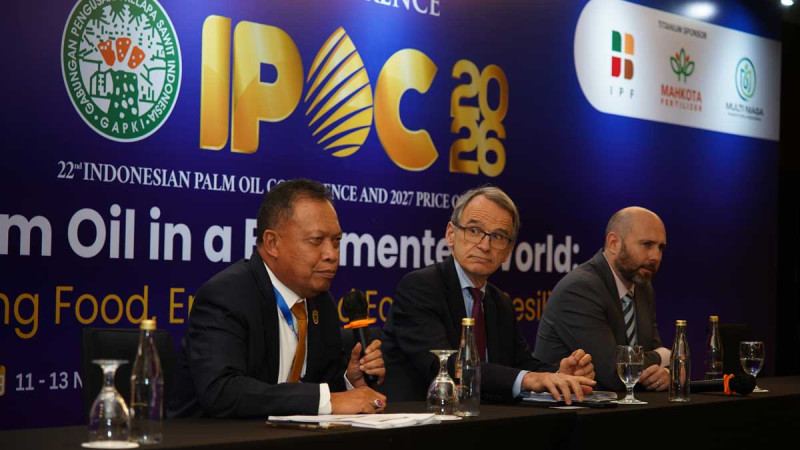
InfoSAWIT, JAKARTA - At a Business Roundtable meeting titled "Unlocking Opportunities: Advancing Indonesia’s Leadership in Sustainable Palm Oil," held by the Global Alliance on Sustainable Planet (GASP) and Indonesia Palm Oil Strategic Studies (IPOSS), Indonesia's Deputy Minister of Agriculture, Sudaryono, spoke confidently about the strategic role of the palm oil industry in the national economy. In front of attendees, he illustrated how this commodity has become a key pillar of economic development, creating millions of jobs and driving rural growth.
"The palm oil industry contributes 3.5% to the national Gross Domestic Product (GDP) and supports the livelihoods of around 16 million people, both directly and indirectly," Sudaryono stated, opening his speech at the event attended by InfoSAWIT in mid-February 2025.
He emphasized that 4.2 million workers depend directly on this sector, while another 12 million earn their livelihoods through the palm oil supply chain. Furthermore, palm oil plays a crucial role in food security by producing around 10 million tons of cooking oil and other food products.
However, significant challenges remain. "We cannot ignore environmental issues, biodiversity loss, and the difficulties faced by palm oil farmers in accessing sustainability certification," he continued. According to him, many palm oil farmers struggle to meet sustainability standards, which ultimately limits their access to global markets.
The government has prepared a comprehensive strategy to address these challenges. With a target of 8% growth in the palm oil industry over the next five years, the Ministry of Agriculture aims to achieve a production level of 100 million tons of Crude Palm Oil (CPO) by 2045. Currently, national production stands at 46 million tons, with 20 million tons for domestic needs and 26 million tons exported to various countries.
To reach this target, three main strategies are being implemented by the government. First, regulatory support. The government collaborates with various ministries and agencies, such as the Ministry of Environment and Forestry and the National Land Agency, to optimize land governance. Additionally, mandatory biodiesel policies and the development of B50 standards are concrete steps to strengthen this sector.
Second, enhancing upstream productivity. The government encourages the rejuvenation of smallholder palm oil plantations, improves plant maintenance, and addresses issues related to plantations located within forest areas. Moreover, the production of superior seeds is prioritized, with a target of providing 420 million seeds to meet domestic needs.
Third, strengthening the downstream sector. The government is expanding biodiesel plant capacities and developing new technologies to improve production efficiency. The standardization of biofuel quality is also continuously updated to ensure the viability of biodiesel use in transportation and industry. (T2)
For more details, read the March 2025 edition of InfoSAWIT Magazine.