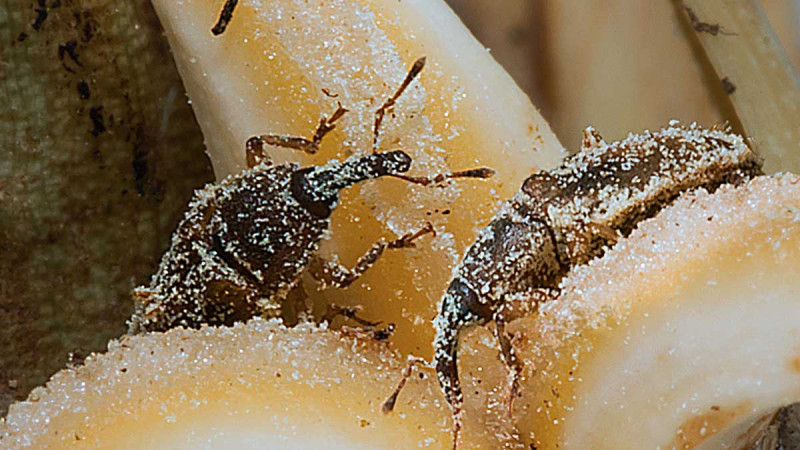
InfoSAWIT, BALI – At a conference attended by researchers and practitioners in the palm oil industry, Mohammad Naim, Head of the Plant Protection Department at the SMART Research Institute, presented alarming facts regarding the impact of extreme temperatures due to climate change on the Elaeidobius kamerunicus beetle, a crucial factor in the oil palm ecosystem.
During the first day of the International Conference on Oil Palm and Environment (ICOPE) Series 2025 at Bali Beach Convention, Naim discussed how increasingly frequent heatwaves could hinder the beetle's effectiveness in pollination.
“The Elaeidobius kamerunicus beetle has tremendous potential to enhance pollination efficiency, but climate change could jeopardize all of that,” Naim stated seriously. He revealed that extreme temperatures experienced in recent years have triggered a crisis that could have widespread implications for the palm oil industry.
The data he presented was shocking. The highest recorded temperature in the Philippines reached 35 degrees Celsius, while in Indonesia, particularly in Lampung and South Sumatra, temperatures soared to 43 degrees Celsius for over five consecutive days.
“We found that this beetle can survive at temperatures up to 30 degrees without significant changes in its population. However, when temperatures reach 43 degrees, all larvae die within a short time,” he explained.
Conference participants listened intently, absorbing the implications of these findings. The pollinator beetle, which has been a natural solution for efficient pollination, is now under serious threat. Its role is crucial in reducing pollination costs, which can reach IDR 1.8 million per hectare.
Laboratory studies conducted by Naim's team tested four different treatments on the kamerunicus beetle under extreme temperature conditions. The results clarified one thing: high temperatures pose a real threat to the development of pollinator beetles. Even though some individuals can survive at 15 degrees, mortality rates increase drastically when temperatures reach higher thresholds.
Questions arose: if heatwaves continue to rise, what will happen to this beetle in the future? Furthermore, what will be the fate of the palm oil industry that relies on their existence?
“We still need further studies to understand how high temperatures affect the efficiency and aggressiveness of beetles in pollination and fruit set,” Naim concluded his presentation.
This fact paints a clearer picture that the challenges faced by the palm oil industry are not only about productivity and regulations but also a battle against the increasingly evident impacts of climate change. Now, efforts to save the beetle are not just about maintaining ecosystem balance but also about securing the future of the palm oil industry that depends on this small beetle. (T2)