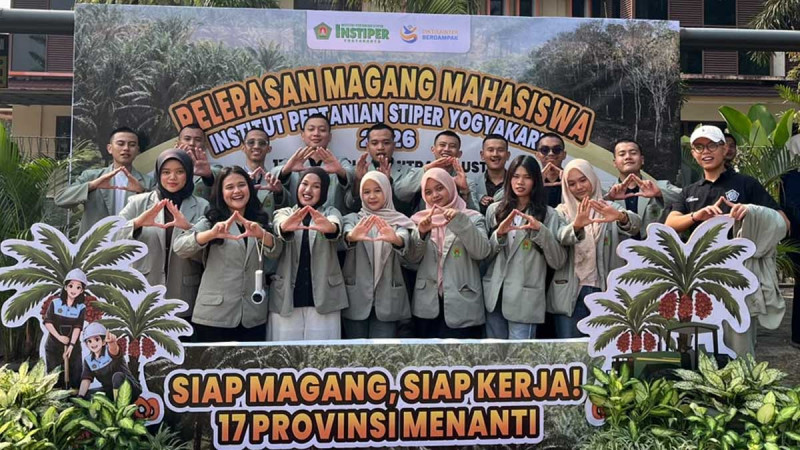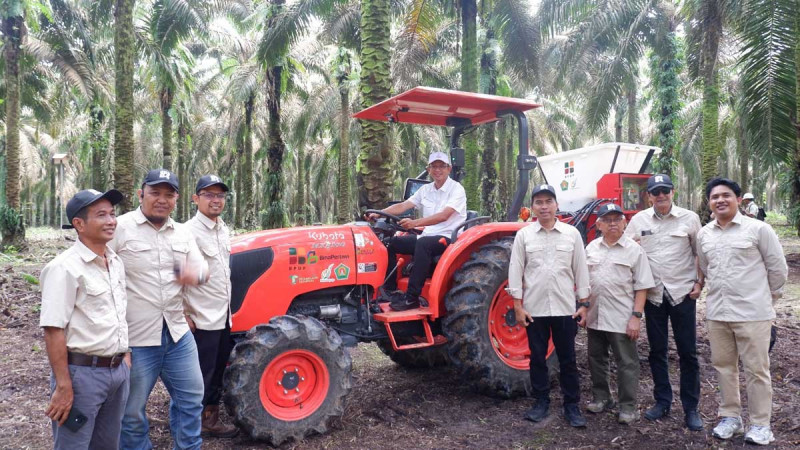
InfoSAWIT, KOTAWARINGIN TIMUR – Technological innovation continues to drive Indonesia’s palm oil plantation sector toward a more modern, precise, and efficient cultivation system. A collaboration between Institut Pertanian Stiper (INSTIPER) Yogyakarta and PT Bumitama Gunajaya Agro (BGA Group) has successfully developed the Autonomous Intermittent Fertilizer Spreader, an AI-based autonomous tractor designed specifically to improve fertilizer application efficiency in oil palm plantations.
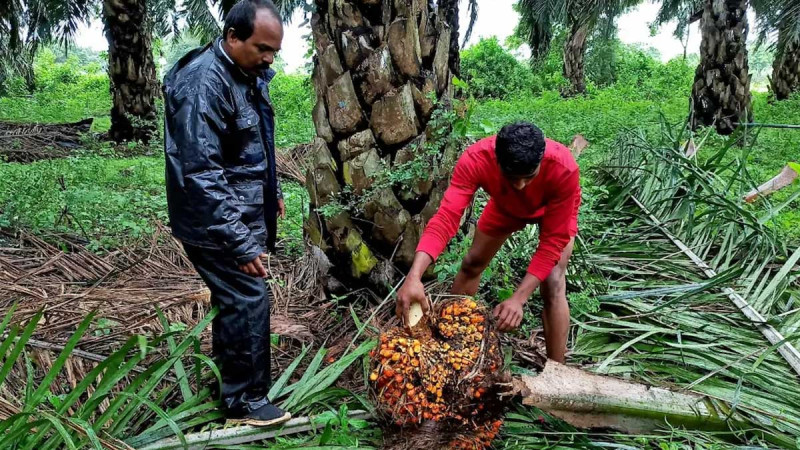
The technology was officially introduced at BGA Group Region 3 plantations in Kotawaringin Timur as part of broader efforts to strengthen plantation mechanization and improve operational cost efficiency.
The machine was developed through a joint research team led by Rengga Arnalis Renjani, supported by funding from Badan Pengelola Dana Perkebunan (BPDP) under the 2024 Palm Oil Research Grant Scheme.
Unlike conventional fertilizer spreaders that distribute nutrients continuously across entire plantation blocks, the Autonomous Intermittent Fertilizer Spreader uses an intermittent fertilizing system, applying fertilizer selectively only at detected tree points.
The technology combines precision navigation, smart sensors, and artificial intelligence capable of detecting palm tree positions with 98% accuracy, ensuring nutrients are delivered precisely to root zones where they are needed most.
“This technology is part of broader efforts to modernize the plantation sector through research and innovation. The intermittent system makes fertilizer application far more targeted while significantly reducing nutrient losses in the field,” Rengga said in an official statement received by InfoSAWIT on Tuesday (28/4/2026).
Higher Productivity, Lower Costs
Field trials showed highly promising performance. The autonomous spreader achieved operational coverage of 30 hectares per day, a sharp increase compared to manual fertilization methods, which average only 2.8 hectares per day.
From a cost perspective, fertilization expenses dropped from around Rp96,053 per hectare to Rp39,500 per hectare, translating into operational savings of approximately 60%.
At large plantation scale, annual savings are estimated to reach Rp374 million, with a projected payback period of only 1.6 years.
Technically, the machine is equipped with a 300-kilogram hopper and a fertilizer spreading range of 5–15 meters. It is compatible with multiple fertilizer types, including NPK, dolomite, kieserite, and rock phosphate, making it highly flexible for plantation nutrient management.
The innovation also delivers occupational safety benefits, as operators no longer interact directly with fertilizer during application, significantly reducing chemical exposure risks.
Project Mechanization Department Head at BGA, Yogi Akbar Hermansyah, said the technology offers a practical solution to the weaknesses of conventional blanket application methods.
“With autonomous navigation and targeted fertilization, efficiency improves substantially while nutrient application becomes more aligned with agronomic needs. Operator safety is also significantly enhanced,” he said.
The collaboration between academia, industry, and government in developing this technology is viewed as a strong model for accelerating plantation modernization and strengthening Indonesia’s competitiveness in technology-driven agriculture. (T2)