InfoSAWIT, JAKARTA – President Prabowo Subianto’s recent remarks regarding palm oil have once again stirred public controversy. Yet, a closer look reveals that similar rhetoric has long been cultivated by previous Indonesian leaders, from the era of Susilo Bambang Yudhoyono to Joko Widodo.
As reported by InfoSAWIT from an article by Faris Rahmadian, a PhD researcher at Wageningen University & Research and Monash University, published in The Conversation on Sunday (April 26, 2026), the evolving rhetoric shows a consistent pattern: Indonesian palm oil is framed as a commodity “under attack,” one that must be defended as part of the national interest.
More than merely an economic commodity, palm oil is increasingly being positioned as part of Indonesia’s national identity. In his research, Faris describes this phenomenon as “palm nationalism”—or “sawitisasi”—a condition in which identity-based narratives risk overshadowing fundamental issues such as social justice and industry governance.
Oil palm was first introduced to the archipelago in 1848 by the Dutch colonial administration, but its expansion accelerated significantly during the New Order era. Under President Soeharto, the sector grew at an average annual rate of 15.07%, accompanied by massive land expansion.
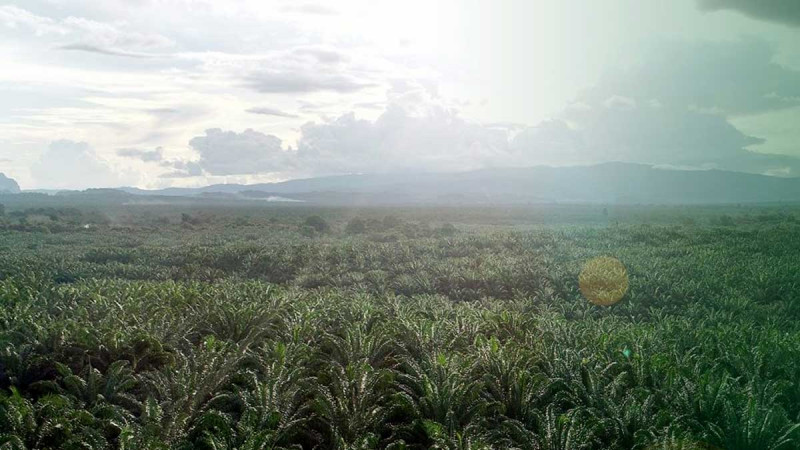
By 2024, Indonesia’s oil palm plantation area had reached 16.83 million hectares. Alongside this growth, international criticism over environmental impacts—particularly deforestation—also intensified.
“The government then responded by shifting the palm oil narrative from merely a commodity to a symbol of national identity,” Faris wrote in his article.
According to him, criticism of palm oil is often interpreted as resistance to Indonesia’s right to develop through its natural resources.
Three Phases of Palm Oil Narrative Transformation
- National Standards Legitimization (2011)
The government introduced the Indonesian Sustainable Palm Oil (ISPO) certification scheme in response to mounting global pressure over sustainability concerns.
This move signaled that Indonesia possessed its own standards for managing the palm oil industry. ISPO also became an instrument to build a more positive global image of Indonesian palm oil.
In 2014, President Yudhoyono openly emphasized the need for courage in defending Indonesian palm oil against negative accusations.
- Geopolitical Phase under Jokowi
Palm oil entered the arena of international diplomacy, particularly after the European Union classified palm oil as a high-risk feedstock for biofuels.
Indonesia responded by filing a dispute at the World Trade Organization (WTO). By 2019, palm oil diplomacy had become one of Indonesia’s foreign policy priorities.
During this period, palm oil was increasingly labeled as:
- Indonesia’s largest foreign exchange contributor
- A pillar of the national economy
- A source of public prosperity
- Global Regulatory Conflict (EUDR Era)
Toward the end of Jokowi’s administration, the European Union introduced the European Union Deforestation Regulation (EUDR), tightening market access requirements for commodities linked to deforestation, including palm oil.
Rather than prioritizing structural reform, Indonesia responded by branding the regulation as discriminatory while intensifying its “Good Palm Oil” campaign.
“This approach deepens the ‘us versus them’ narrative and shifts palm oil from a technocratic issue into a symbol of global resistance,” Faris wrote.
Institutionalizing Palm Nationalism
Palm nationalism is no longer merely rhetorical—it is becoming institutionalized across sectors.
In education, the government has introduced scholarship programs specifically for children from oil palm Smallholders families. In religious circles, Islamic organizations are developing palm-based economic initiatives within pesantren (Islamic boarding schools). Even the military has been involved in securing plantations as part of national asset protection.
These three pillars—education, religion, and the military—have become important elements in embedding palm oil into everyday social life.
The Risks Behind Palm Nationalism
Faris warns that this phenomenon carries serious consequences.
When palm oil becomes intertwined with nationalism, defending it is seen as patriotic. Conversely, criticism may be labeled anti-national or contrary to state interests.
“This situation is dangerous because it threatens civil liberties while obscuring real problems such as deforestation, human rights violations, and social inequality,” he wrote.
More broadly, such narratives may also serve as a tool for the state to avoid accountability in reforming governance in the palm oil sector.
The evolution of palm oil—from an economic commodity into a national symbol—highlights its growing complexity, positioned at the crossroads of development, geopolitics, and identity.
Without structural reform, identity-based approaches risk prolonging social injustice and environmental crises.
“An orientation toward identity must not overshadow the need for fair and sustainable governance,” Faris noted. (T2)