InfoSAWIT, JAKARTA - Indonesia, as the biggest palm oil producer in the world, has the big potential to optimize palm oil waste from the industries. One interesting innovation is making palm oil sticks to be qualified fashion products, for instance, bag, clutch, sandal, and hard cover. The things mentioned above happened because of available materials and to minimize palm oil waste to create economical additional values.
Febri Yuniarta, the owner of Cambiacraf said that the main material – palm oil sticks would have maximal potential which many did not take for advantages. Palm oil sticks were ignored or thrown away or even burnt. Many did not realize that the sticks have economic advantages.
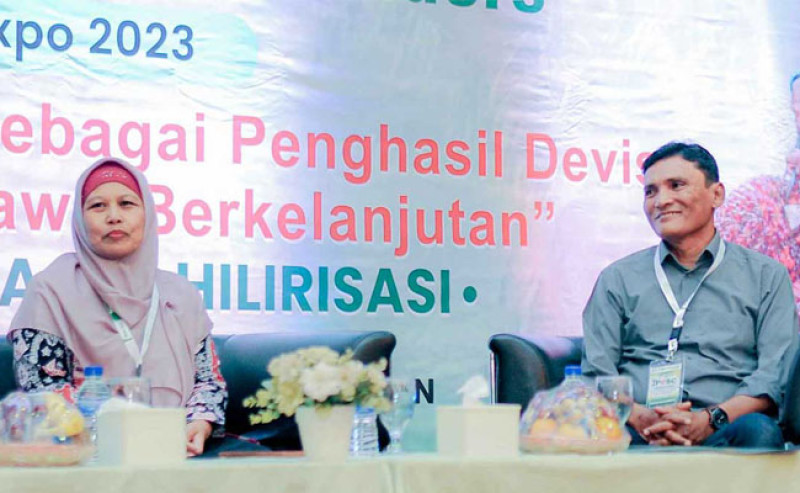
“By choosing palm oil sticks as the basic materials to make fashion products, it would be delivering spirit for the people that by creativity and innovation, every waste could be changed to be high products,” she said as one of speakers in Indonesian Palm Oil Smallholders & Conference (IPOSC) that POPSI conducted in cooperation with Palm Oil Plantation Fund Management Agency in the session “Potensi dan Inovasi Sawit Bagi Petani Sawit”, that InfoSAWIT attended by the late of November 2023 in Jambi.
The products mentioned above were made of palm oil sticks. Febri Yuniarta mentioned that her side also did trainings to empower the local people to create not only new economic chances but also reduce palm oil tree – wastes through reduce, reuse, and recycle (3R) principle.
The first, in reducing palm oil tree – waste, the wastes after producing bags, clutch, and sandal, were produced to be card holder (product). The second, by re-cycling palm oil sticks, the wastes which were useless – thought, would be the materials within higher value. The third, by improving and escalating palm oil stick web- quality, the initiative would support recovery principles.
Palm oil sticks have unique characteristic within 90 – 120 cm long, yellowing brown, mostly round – texture, harder and flexible. Empty bunches were processed by using hand – made machine to get fiber. Then it was used to produce bags, shoes, and paintings.
The other creation from palm oil as the material is palm oil grass stick. Prior palm oil grass was known as the material to make ‘dodol’. The fact showed it could be processed to be delicious, nutritious snack, such as, palm oil stick grass.
The making of palm oil grass stick is one innovation from independent smallholders in Village of Tanjung Makmur, Sub district of Merlung, District of Tanjung Jabung Barat, Jambi Province.
The maker of palm oil stick grass, Nurhidahay said that the innovation is not only about variants but also making the products as unique and healthy snack.
She who is also the member of Serikat Petani Kelapa Sawit (SPKS) Jambi told the ways to process it. The material should be palm oil grass. Make sure that it is clean and qualified. The ingredients are wheat flour as the dough.
“By this creation, we take for advantages the local materials creatively and we create alternative snack to be new one in culinary world,” Nurhidah said.
Meanwhile Chairman of Perkumpulan Forum Petani Kelapa Sawit Jaya Indonesia (POPSI), Pahala Sibuea said palm oil wastes could be taken for advantages to innovate, such as, organic fertilizers, bioenergy, briquettes or materials for handy-crafts, for instance, empty bunch – fiber cold be processed to be web or other products.
These would be delivering new chance to diversify the smallholders’ income because advantaging the waste could be done in the spare time when planting because many smallholders would not be in their plantations all day.
The next thing is to create sustainable business model and deliver incentive for them to actively innovate. Partnership among the government, researchers, other stakeholders would accelerate idea implementation. It would need technical helps, fund, and market access to encourage smallholders in adopting new practices.
“The success of innovative projects would escalate not only their income but also deliver the positive impacts to sustainable environment. By taking for advantages on palm oil waste efficiently, we would minimize the negative impacts in palm oil industries for the environment but create business model sustainably,” he said. (T2)