
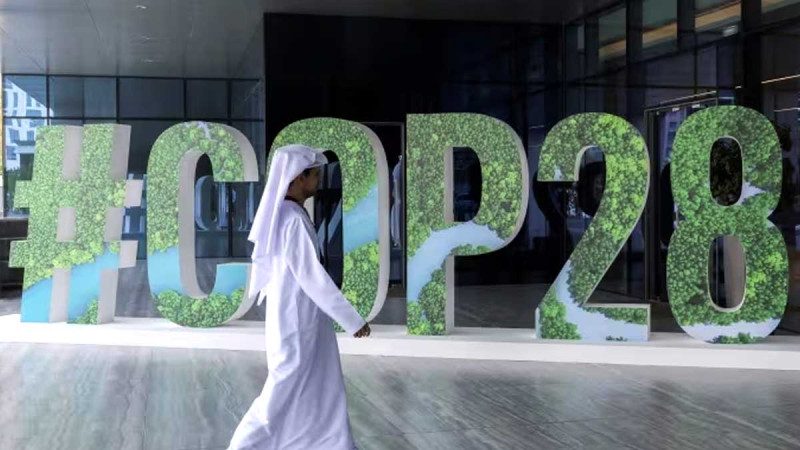
InfoSAWIT, JAKARTA – The 28th Conference of Parties (COP28) in Dubai, United Arab Emirates on 6 - 18 November 2023 ended with disappointment. The countries (participants) failed to get ambitious agreement to get green-house gas (GHG) emission reduction to prevent the increasing temperature not more than 1,5 Celsius degree.
Global stock take (GST) found that the implementation of nationally determined contribution (NDC) from the countries that ratified Paris Agreement would reduce GHG about 2% in 2030 compared to it in 2019. In fact, the target to get 1,5 Celsius degree, GHG emission should decrease 50% in 2030 and would be in net zero emissions in 2050.
“The world was sorry because COP28 did not get firm mandate to phasing out fossil fuels, such as, coal, crude oil, and natural gas. If they really refer to science, many countries should minimize coal use for about 95%, crude oil 60%, and natural gas 45% in 2050,” Forest and Plantation Manager Wahana Lingkungan Hidup (WALHI), Uli Arta Siagian said, as in the official statement to InfoSAWIT recently.
The slow response in climate action made the people confused to face the impacts of climate changes, such as, extreme hot weather, flood, high wave, drought, and spread of diseases, the loss of housing, source of living, and cultural sites. The biggest impacts are for the disability, elder, children, female, indigenous people, local, farmers, traditional fishermen, and labors.
Data from National Disaster Management Agency in the past decade showed that more than 90% disasters happened had something to do with climate and the victims reached more than 32 million.
In the agenda of Global Goals on Adaptation, COP 28 successfully formulate the goal cover of adaptation but it had no clear targets. There should be acknowledgement to local wisdom to adapt and indigenous people leadership to adapt, but it was not clearly mentioned about tenant protection as the pre-condition of adaptation in local and traditional knowledge (wisdom).
“To confirm fair and sustainable climate solution, every party including the regional governments, the vulnerable people should get involved meaningfully. But the country should not give up to solve the climate crisis situation,” Executive Director of Yayasan MADANI Berkelanjutan, Nadia Hadad said.
As a country with the second largest tropical forests in the world, Indonesia made forestry and land luse as the basic one to minimize GHG emission. On the other hand, Indonesia as the archipelago country, is vulnerable to climate crisis particularly from the increasing sea surface that could drown small islands and risks to lost houses
“Natural forests keep vanishing, small islands are threatened, unfair energy transition damage the environment, take the people’s rights, damage the coasts, water, coral reefs and mangrove. The people’s economic source get lost,” Executive Director of Yayasan PIKUL, Torry Kuswardono said.
The civil societies noted that in 2001 - 2022 6,5 million hectares of natural forest canopy and mangrove got lost. 176 thousand hectares of the numbers happened in the past three years. (T2)