
InfoSAWIT, JAKARTA – Palm oil plantation industry that was only in one province now develops to operate in 24 provinces and the plantations laid on about 16,381 million hectares from only 261.000 hectares. But in the last four years, the decreasing production should be a serious threat. It needs action fast to stop the decreasing production.
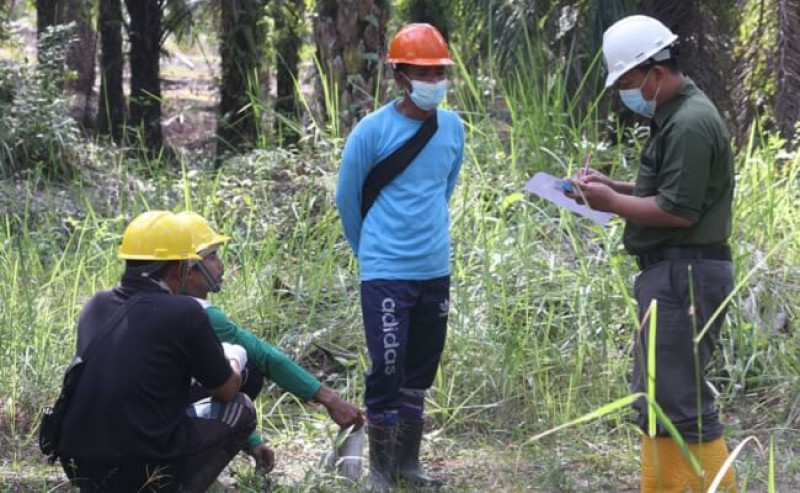
One main challenge that the smallholders are facing is the low productivity. This happens for some factors, such as, the seeds derived from unofficial sources or fake seeds, the low implementation of good agricultural practices (GAP), and limited human resource (HR) and institutions. It is also indicated that their plantations may be developing in forest, peat regions, and there is no certifications, such as, sustainable and halal, cultivation documents, and Indonesian Sustainable Palm Oil (ISPO).
To solve the issues, Mula Putera of Directorate of Palm Oil and Various Palm General Directorate of Plantation Ministry of Agriculture, said that it needs more harmonious partnership between regulation and planters. Some factors that made it were allocation and plasma plantations, decision to get candidates from the smallholders, and the lack of socialization.
“The solution was proposed by having socialization about related regulation and responsibility, transparency, evaluation in scale, coordination, reinforcing HR and smallholders’ institutions,” he said.
Mula also mentioned the supply chain would be complex and made the smallholders’ profit get decreased. The ideal is that independent smallholders should get partnership with palm oil plantation company without having long supply chain.
“Partnership between small, medium, and big businesses in palm oil sector is clearly regulated. But there are disharmonious implementations between regulation and implementation. That is why it needs development from medium and big businesses to small ones by noticing the profitable principles that need, reinforce, and deliver profits one to another,” Mula said.
Chairman of Persatuan Organisasi Petani Sawit Indonesia (POPSI), Pahala Sibuea said to escalate smallholders’ competence and capability, it is acknowledged or not, it needs trainings, and information, and fund support to escalate their knowledge about good agricultural practices to realize sustainable palm oil.
He also told that HR development in palm oil sector would be the key to escalate their knowledge, skills, and competitiveness.
It should not be for smallholders only but also for labors in palm oil plantations. The labors should be managed well so that their rights would be accommodated with social and labor insurance.
“Education and trainings would make the plantation production and productivity increase. Palm oil industries would be sustainably cultivated from the upstream to downstream sectors. The goal is about to get productivity 30-40 tons of fresh fruit bunch (FFB) per hectare per year, the yield 23 - 25%, and high level – sustainability,” he said, as in the official statement to InfoSAWIT, Friday (15/12/2023).
Director of Finance, General, Compliance and Risk Management Palm Oil Plantation Fund Management Agency (PFMA), Zaid Burhan Ibrahim said that cultivation practices in smallholders’ level significantly shifted from the conventional methods to more modern ones. The smallholders tend to implement much better knowledge to escalate their efficiency and production results.
But it is important to integrate upstream and downstream sectors as the main focus in modern cultivation. By having research, infrastructures, and other activity, everything would support them to maximize their palm oil harvest. The products, such as, bulletproof clothing, batik, and other innovation from palm oil would significantly create additional values.
“Smallholders replanting program would be the main instrument to realize the smallholders’ welfare. With the target 180 thousand smallholders per year, the grant - Rp 30 million per hectare at the maximal 4 hectares, would significantly encourage financial support,” he said. (T2)