InfoSAWIT, JAMBI – There is no impossible thing if it is done by synergy. That should be in palm oil sector, which is, synergy among smallholders, government, and companies to get palm oil go forward and smallholders as material suppliers for industries or companies.
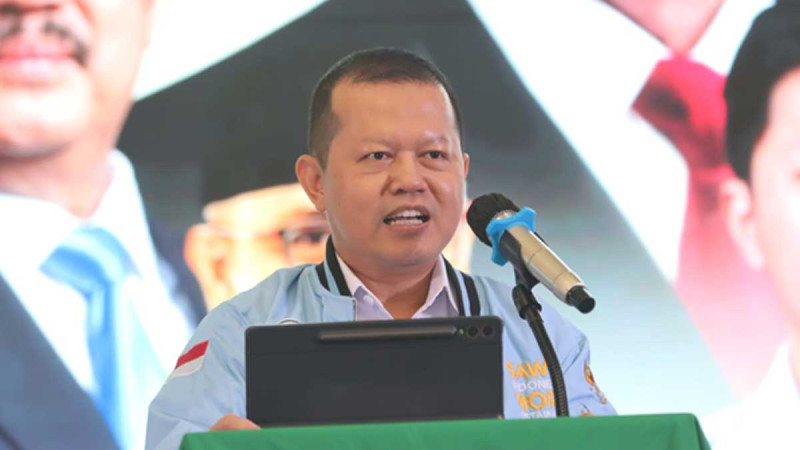
Vice Governor of Jambi, Abdullah Sani said that Jambi lays on about 5.343.500 hectares. The numbers consist of 9 districts and 2 cities. Still form the numbers, about 36,18% are plantation areas (1.933.322 hectares/ha).
From the numbers, 20 plants are developing in Jambi Province and they contribute to the people’s economy. Of 20 plants, seven of them are the main plants, they are, palm oil, rubber, coconut, coffee, cassiavera, areca nut, and sugarcane. They lay on about 1.924.910 ha.
“In this case, plantation subsectors significantly play big roles for the people’s economy because 73 % of the seven main commodities are people’s plantations. Only 27 % belongs to the plantation companies,” he said when inaugurating The 3rd Indonesian Palm Oil Smallholders (IPOSC) with the theme ‘Optimalisasi Sawit Rakyat Sebagai Penghasil Devisa di Pusaran Tata Kelola Sawit Berkelanjutan’ that Palm Oil Plantation Fund Management Agency (PFMA) supported in Jambi (28/11).
Abdullah also mentioned that Jambi Province thought that plantation subsectors are the main ones for contributing 17,8% to gross regional domestic product in the province that reached Rp 37 trillion.
“We exported 24 commodities to America, Europe, Asia, Arab peninsula with the total about Rp 1,9 trillion that made Jambi as the third biggest commodity exporter in Indonesia,” he said.
He also hoped that the achievement should be the trigger to make better. Jambi Province would publish policy needed to escalate (the exports), such as, would maximally implement Jambi Province Regulation Number 19 / 2019 about Plantation Commodity Commerce.
“Through the regulation, we hope that every planter would get additional values and better bargaining position to escalate their welfare in Jambi,” he said.
Not only that, Abdulah suggested there should be equal partnership between the companies and planters or smallholders to develop self-reflection process, escalate capability process, and social modal development. It is hoped that the partnership would be the communicative community to develop plantation business naturally and the journey process would develop to be solid institution and be harmony because it was established by social modal, and would synergize the power from every partnership actor. For information, Jambi has 16 palm oil plantation companies.
Director of Finance, Public, Obedience, and Risk Management PFMA, Zaid Burhan Ibrahim said that cultivation practices in smallholders’ level significantly got shift from conventional to more modern methods. The smallholders tend to implement better knowledge to escalate their efficiency and production.
But it is important to get integration in upstream to downstream sector as the main focus in modern palm oil cultivation. Through the research, infrastructures, and others, everything would support them to maximize palm oil output advantages. The products, for instance, bulletproof clothing, batik, and others derived from palm oil, would create additional values significantly.
It is acknowledged or not, the research would be the important thing to escalate palm oil productivity. By having sustainable research, the smallholders would escalate the cultivation techniques and would take for advantages on innovation to realize more optimal results. “Every research was made to escalate smallholders’ plantation productivity,” he said.
Price stability issue would be the key in sustainable palm oil industries. Biodiesel program which becomes one important initiative, would deliver incentive for smallholders. Fresh fruit bunch purchase by PT Pertamina to be sold with biodiesel at Rp 6000 per liter, would create price stability for smallholders. The program would play its role to encourage environmental energy use.
The research program to change palm oil to be bio-hydrocarbon is the breakthrough in advantaging palm oil in wider perspective. The initiative is mandated to PFMA with the goal, to escalate the people’s welfare.
“Smallholders replanting program would be the main instrument to realize smallholders’ welfare. With the target 180 thousand hectares per year, grant about Rp 30 million per hectare within maximally four hectares, these would deliver financial encourage significantly,” he said. (T2)