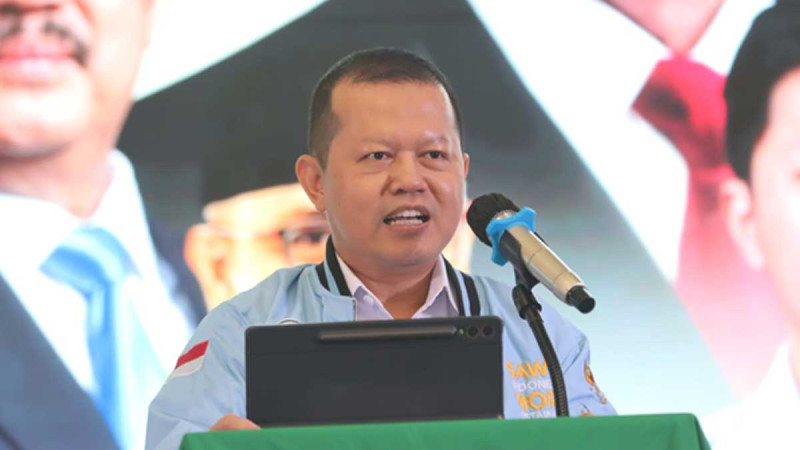
InfoSAWIT, JAKARTA – General Secretary of Indonesian Palm Oil Association (IPOA), M. Hadi Sugeng was recently sorry about palm oil industrial progress in Indonesia. Though Indonesia is the biggest palm oil producer and exporter in the world, palm oil consumption in the globe for the next years would not be balance with its production in this country, both in crude palm oil (CPO) and palm kernel oil (PKO).
He also mentioned that palm oil production in Indonesia was stagnant for the past years and the exports decreased though the volume increases this year.
“In the past few years palm oil production in Indonesia was stagnant at 51 million tons; the exports were decreasing. Though export volume increases this year, the value decreases because of its price,” M. Hadi Sugeng said at Gala Dinner of the 25th Kongres Persatuan Wartawan Indonesia (PWI), Gedung Sate, Bandung (24/9/2023).
In fact, Indonesia now masters about 58% vegetable oil markets and more than 40% palm oil markets in the globe. The major issues in Indonesia’ palm oil commodity are overlapping policies and many instances involve in publishing policies.
Hadi Sugeng thought, at least there are tens government’s institutions that published policies in palm oil sector from the regional to central governments. The real sample he said was about forest region identification. Many palm oil plantation companies got business rights or smallholders got certificates on their land. But what the companies and smallholders got, are now categorized as forest regions both by governors’ recommendations and other related instances.
“After we calculated, at least, 31 government’s instances published policies, starting from the regional to central governments,” he said.
Actually, he continued, the stakeholders or smallholders that got business rights or ownership certificate must have the legal certainty because every process (to get the rights and certificate) involved many related instances and considered available spatial. To solve these issues, the Government of Indonesia implements Government Regulation in Lieu of Law Number 2 / 2022 about Cipta Kerja. It regulates to pay administrative fine for every stakeholder and should return plantations in forest regions after one cycle of planting.
Meanwhile Treasurer of PWI, Muh. Ihsan told his support for palm oil industries. He thought the sector is very strategic for Indonesia, contributing significantly for the social and economy, helping to welfare the people of Indonesia. (T2)