InfoSAWIT, JAKARTA – Palm oil industries still depend on palm oil production which 50% of the production is from Indonesia. The high demands would directly impact to palm oil products in Indonesia.
Crude palm oil (CPO) which is the material to produce palm cooking oil and bioenergy is needed by the people of Indonesia. The high market demands from many consumers become the description of the fast food and non-food industries in the world including in Indonesia.
CPO as the biggest vegetable oil in the world could be the substitution for other kinds of vegetable oils. They are hardly applied as food and non – food materials and it makes palm oil can be as the substitution used in food oil and its derivative industries when the major oils used get something problem in their supply.
The markets in the globe has deficit of supply because of the war between Russia and Ukraine. The war, based on some experts said, delivered significant impacts to, at least, 34 countries in the world. The two countries (Russia and Ukraine) are the sunflower oil supplier to the globe and it has issue and even is stopped to deliver supply to many countries.
As the result, the lack of vegetable oil supply namely from sunflower oil directly delivered impact to CPO which increased in demands. On the other hand, CPO markets always get increasing selling price because of the slow production, climate, and others. The limited production directly influenced the increasing CPO and its derivative selling price.
Besides, CPO increasing selling price which is used as material of bioenergy, which is, biodiesel, has the same issue though it is not similar. As the government’s mandatory program, biodiesel delivered impacts to save the revenue. CPO increasing selling price is helped by advantaging the fund from Palm Oil Plantation Fund Management Agency (PFMA) as biodiesel incentive.
Analyst of Expert Policy Coordinator Ministry in Economy, Khadikin said Indonesia is still the epicenter of palm oil producer and consumer in the world, becomes the focus of CPO price decision dynamic in the world for having its magnitude in supply and demand – side.
While the actual markets of vegetable oil in the world show high vulnerability and sensitivity about strategic environmental changes. Khadiki mentioned, when Russia started to invade Ukraine in April 2022, CPO price got much cheaper to be RM 1.000/metric ton (MT) in just three days in the globe.
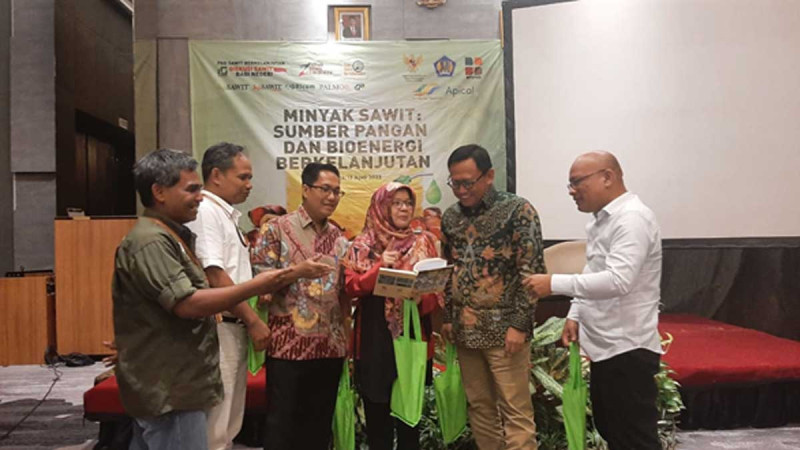
“It happened for Ukraine is the major sunflower oil producer which is as CPO competitors from tropical countries, namely Indonesia and Malaysia,” he said in Focus Group Discussion (FGD) SAWIT BERKELANJUTAN VOL. 13, with the theme “Minyak Sawit: Sumber Pangan Dan Bioenergi Berkelanjutan”, that InfoSAWIT did and supported by PFMA, Thursday (13/4/2023) in Jakarta.
In the early of 2023, other vegetable oil supply in the world got better. It was hoped that CPO got much cheaper for the winter season started in sub-tropical countries and religious days but the fact showed that CPO did not get better significantly.
“It needs to anticipate by reinforcing supply and demand policy in national level so that CPO price would not significantly impact to fresh fruit bunch (FFB) price that smallholders produced,” Khadikin said.
He continued that the government is encouraging that Indonesia could become CPO price maker in the world because Indonesia is the major CPO producer in the world. This has to be by establishing commodity exchange.
Division Head of Biodiesel Development PFMA, Nugroho Adi Wibowo said PFMA is a public service obligation which gets mandate to manage and distribute palm oil plantation fund.
Fund distribution should base on policy and authority that ministry/institution regulated. The success of fund distribution including the impact would depend on design and implementation of any program.
“Biodiesel incentive (B30) is the policy and authority from Ministry of Energy and Mineral Resource. Implementation design and complaint of program implementation are decided by the ministry based on the Regulation of Minister of Energy and Mineral Resource Number No. 24 / 2021,” he said.
Nugroho also said that biodiesel incentive distribution since 2015 to March 2023 reached Rp 144,7 trillion. The highest distribution was in 2021 that reached Rp 51 trillion. In 2022 it decreased to be Rp 34,5 trillion. “But one information is that tax contribution from biodiesel which was paid through income tax, reached Rp 13,15 trillion,” he said.
Not only biodiesel, incentive fund support was also delivered to palm cooking oil industries based on the President’s Regulation Number 61 / 2015 juncto President’s Regulation Number 24 / 2016 juncto President’s Regulation Number 66 / 2018 about Palm Oil Plantation Fund Allocation and Collection; then Regulation of Minister of Trade Number 3 / 2022 about Packaged Palm Cooking Oil (in simple and packaged) and the Regulation of Minister of Industry Number 8 / 2022 about Bulk Palm Cooking Oil.
About incentive distribution of bulk palm cooking oil, Nugroho continued, by October 2022 PFMA paid up to 80% or about Rp 62 billion or about 12.479.534 kilograms to 10 stakeholders. The process was running by surveyor tenders.
(Simple) packaged palm cooking oil is on process to publish verification result by Ministry of Trade that PFMA would be using as the basic to pay the incentives.
“PFMA is still waiting for the legal consideration from Deputy Attorney for Civil and Government Administration, General Attorney to get accountability principles, good governance, and to anticipate the legal consequence potential that may happen in the future,” he said.
Director of Marketing Holding Perkebunan Nusantara PTPN III (Persero), Dwi Sutoro mentioned that the fundamental issue in palm cooking oil always happening in Indonesia is not about supply and production capacity but its price and distribution. “Namely if CPO price as material gets more expensive,” he said.
CPO application statistic in Indonesia is that 15% of CPO production in national scale or about 6,8 million tons is used to be the material to produce palm cooking oil; compared to 55% which is used to export. Housing application reached 62% and non – housing application reached 38%.
That is why palm cooking oil procurement, as he suggested, should focus to the volume which relates to palm cooking oil industries. The policy about palm cooking oil should answer every issue about price, distribution, and mechanism.
The policy implementation nowadays, Dwi continued, still has risks from subsidized palm cooking oil continuity. If CPO gets more expensive, subsidy would be more (there would be margin loss) namely from palm cooking oil producers which are not integrated with CPO industries.
Olein price in the globe is not similar with the increasing CPO price in the domestic. This issue has no compensation from the margin loss from palm cooking oil producers. This is contradictive with olein price in the domestic which is more expensive that makes incentive in the form of export permit, is less interesting. That is why many producers chose not to produce subsidized palm cooking oil.
Distribution scheme is still dominated by the private and affiliation from private palm cooking oil producers and uses normal one. “That is why in the future, it is better the distribution is taken over by company/Enterprises and using its distribution for special subsidized palm cooking oil,” Dwi suggested.
He continued that PTPN is now developing capacity and capability to escalate the roles and involvement of the country, for instance, by escalating palm cooking oil production capacity. PTPN is preparing it as part of national strategic project within 3 million tons of capacity per year; the second, preparing pilot project of red palm cooking oil within 10 tons/day.
Head of Industry & Government Relations Apical, Manumpak Manurung said that Apical is one producer that gets mandate to produce Minyakita from the government within the highest volume production of other 10 palm cooking oil producers. It reached 89.072 thousand tons/month or about 22 percent from domestic market obligation (DMO) of Minyakita that reached 450.000 thousand tons per month.
That is why Manurung continued, to make sure Minyakita production that Apical produces based on the highest retail price (HRP) from the government, the company does HRP education to the people by encouraging them to report if Minyakita is sold more than HRP to call center which the company provides. “To be monitored by the regulators,” Manurung said.
About FGD Sawit Berkelanjutan:
FGD Sawit Berkelanjutan is an interactive discussion by palm oil stakeholders in national scale. It presents speakers from many sectors to deliver complete description about palm oil existence. The goal is about to deliver the right understanding about palm oil contribution and existence for the country, social, and environment.
Diskusi Sawit Bagi Negeri gets fund support from Palm Oil Plantation Fund Management Agency (PFMA), Holding Perkebunan Nusantara, and Apical within strategic media partner - Media InfoSAWIT and Palm Oil Magazine. The discussion that involved many stakeholders, such as, from the government, planters, researchers, organization, social, environmental activists, and others discussed palm oil in Indonesia to be better.
If you need more information, please contact us, Ignatius Ery Kurniawan through Whatapp (WA) at 081284832789, e-mail: sawit.magazine@gmail.com