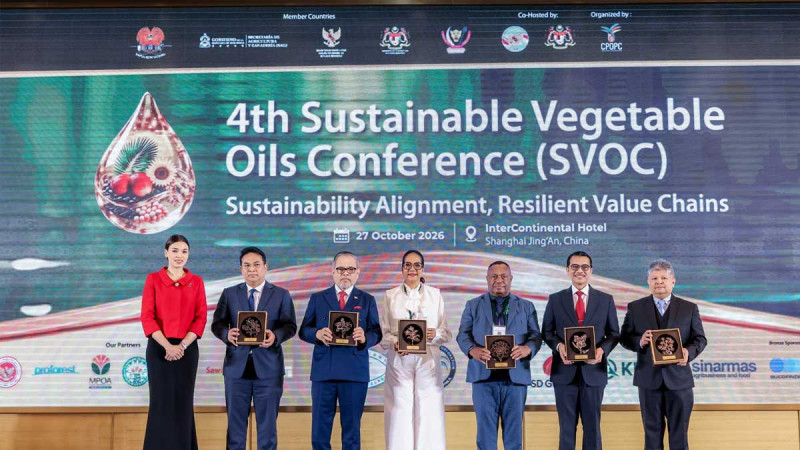
InfoSAWIT, BRUSSELS – On 8-9 April 2019 the Crude Palm Oil Producer Countries (CPOPC) visited European Union (EU). The joint mission was led by Coordinator Minister in Economy, Indonesia, Darmin Nasution while Malaysia was led by General Secretary of Malaysian Primer Industry, Dato ’Dr. Tan Yew Chong. Columbia was as the observer and represented by Felipe Garcia Echeverri, who is also the Embassador of Columbia for the Belgium, and the Head of Mission for EU.
In the official statement to InfoSAWIT, Tuesday (9/4/2019), the mission was the follow up from the agreement in the 6th Ministrial Conference of CPOPC which was held on 28 February 2019 in Jakarta, Indonesia to protest the policy of the 2018/2001 European Union Renewable Energy Directive II (Delegated Act) and involved to make dialogue with the leaders of EU to what the CPOPC concerned about. In the meeting, they agreed to discuss the discriminatory of Delegated Act by EU authority.
The members of CPOPC noticed that the policy is as the political compromise in EU within the goal, to isolate and put palm oil aside from renewable energy which may mandate to give profits for other kinds of vegetable oil which are less competitive. The CPOPC thought, the regulation is to limit and effectively forbid every palm oil to be produced as biofuel in EU through the unscientific misconcept from Indirect Land Use Change (ILUC).
The criteria has no basic as the reference in the Delegated Act which intentionally categorized that palm oil is the main factor of deforestation but has nothing to consider the wider environmental issue when developing other kinds of vegetable oil, such as, rapeseed.
CPOPC also thought, the regulation is as the unilateral tool to the palm oil producers that might not realize the poverty alleviation and sustainable development goals (SDGs).
“We really protest the Delegated Act which classified palm oil as unsustainable commodity because of high risk ILUC. CPOPC thought that EU published the regulation to erase and ban palm oil imports to renewable energy which EU mandated to promote kinds of vegetable oil in their own countries. CPOPC really concerned that the assumptions have no accurate criteria and scientifically discrimination,” Darmin noted.
The claim published by EU Commission that the Delegated Act is based on unproper environmental and scientifi reasons. For example, soybean oil from the selective source is categorized as low risk ILUC though the EU internal research concluded that soybean is the most responsible commodity to the deforestation.
This raised question to the Delegated Act and its probability that the political and economic protectionism rather than scientific decision is the real factor to publish it. CPOPC though that this would be the loss to eliminate palm oil from EU countries to trade.
“During the mission, we told our concern to the leaders and the authority in EU and we provided the solution so that every side could accept,” Darmin said. (T2)