InfoSAWIT, JAKARTA – Palm oil plantation issues are not about the environment only. As one industry full of men, the issues about labor and gender are still in debate.
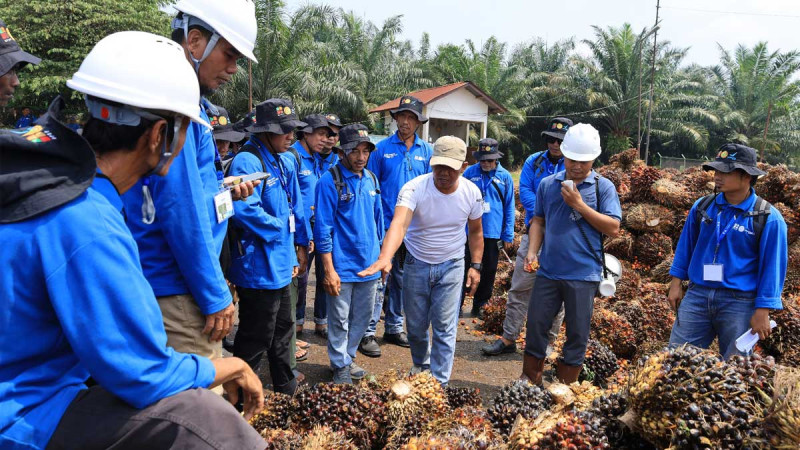
There are lots of stories in palm oil plantation development in Indonesia. The industries need many labors (workers) but still face the issues.
Data from Coordinator Ministry in Economy revealed that palm oil sector could hire direct workers about 4,2 million men and 12 million men indirect workers. The agricultural sector (the people’s plantations) could have about 2,6 million kinds of businesses that hire about 4,3 million men.
In the economic level nationally, palm oil industries could give the biggest exchange to the country and they play roles to fulfill and realize Sustainable Development Goals (SDG’s) to minimize the poverty, increase the people’s economy of 14 million smallholders and their family.
But the high employment in the palm oil plantation sector is still in debate, such as, the violation assumption of human rights by the child labor and gender.
In one side, palm oil plantation could be positive to provide employment but there would be assumption which needs field evidences. It is assumed that the workers are hired by violating the regulation.
It is also assumed that they work unfairly, they do not get their rights based on the regulation, and they are mostly female.
In the plantation female workers are involved in many cases (kinds of works) and they should be protected and should have the same rights with the male (fairness in gender). The fair gender is not about the same treatment between the male and female. It is realized that the female and male are different naturally.
Titik Sumarti of Institut Pertanian Bogor (IPB) told that the similarity is about their rights which should be given fairly according to the gender. If the female is as a driver in the plantation, for instance, she needs to get her needs, protection, and get shelter to stay apart from the male.
Yayasan Pemberdayaan Perempuan Kepala Keluarga (PEKKA) in palm oil plantation noted that many female workers still get minimal protection.
For example, Mesriani (50) of Kubu Raya, she works at the nursery from 7 to 11:30 a.m, she gets Rp 30 thousand per day but there is no guarantee if she gets accident.
Founder and Chairman of Yayasan PEKKA, Nani Zulminarni said that the female workers always face ‘no option’ when having negotiation. The weakest group in palm oil plantation worker should sacrifice their needs to get agreement from certain parts. “The concept of capitalist companies is that the freelancers are parts of the production but they are not partners,” she said.
This happens for the condition, such as, there many workers to get in Indonesia. Having additional numbers about Rp 10 to Rp 30 thousand, the female workers who are as the housewives really need it. The capital owner knew this to minimize the production cost as small as possible to get the profits.
Who would be responsible on this? Nani told that the government should be responsible for having the authority to implement the policies and legal and or make the new regulation which never published.
“We have the Laws about Worker Protection and in more sensitive perspective, the gender. But the government does not regulate the workers in the nursery and fertilizer sectors,” she said.
Source: InfoSAWIT, September 2020