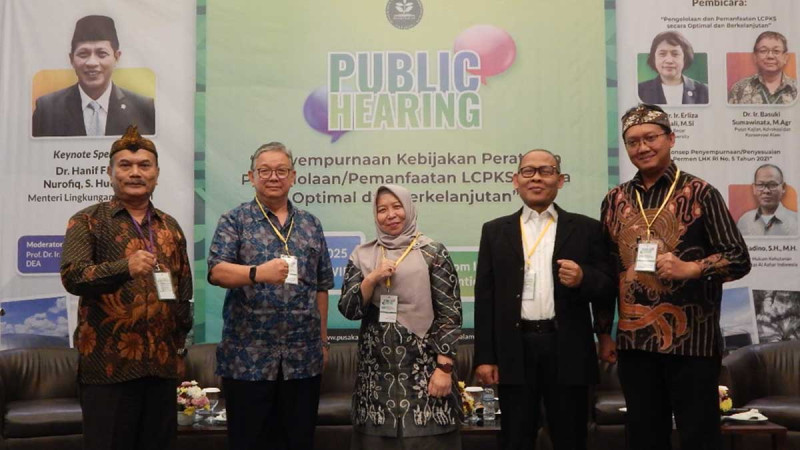
InfoSAWIT, BOGOR – The management of Liquid Waste from Palm Oil Mills (LCPKS) was the main topic at a Public Hearing organized by the Center for Study, Advocacy, and Nature Conservation (PUSAKA KALAM) at the IPB International Convention Center in Bogor. The event explored opportunities and challenges in utilizing LCPKS as a high-value resource, both as liquid organic fertilizer and renewable energy.
The discussion, which involved academics, government officials, and industry representatives, emphasized the importance of technology in transforming LCPKS from waste into solutions for the agricultural and energy sectors. Several proposed mechanisms included refining waste treatment systems at Wastewater Treatment Plants (IPAL), improving technical guidelines for Land Application, and implementing technologies such as Methane Capture and Biodigesters.
Although various Palm Oil Mills (PKS) have adopted these methods, their implementation is still hindered by regulations that have not fully supported them, especially following the revocation of Ministerial Decree No. 28/2003.
As a strategic step, PUSAKA KALAM has prepared an academic manuscript titled "Optimal and Sustainable Management of LCPKS," which is expected to serve as a foundation for policy refinement. This Public Hearing provided a platform for discussion to enrich the substance of the manuscript before it is submitted as a policy recommendation.
With key speakers including Dr. Ir. Basuki Sumawinata, M.Agr (Researcher at PUSAKA KALAM) and Prof. Dr. Ir. Erliza Hambali, M.Si (Professor at the Faculty of Agricultural Technology, IPB University), the event delved into optimal management of LCPKS.
According to information obtained by InfoSAWIT on Saturday, February 8, 2025, the legal and policy session featured Dr. Sadino, S.H., M.H. (Forest Law Expert at Al Azhar University Indonesia) and Dra. Harni Sulistyowati (Junior Environmental Impact Control Expert, Ministry of Environment and Forestry of the Republic of Indonesia), who highlighted the need for regulatory revisions, particularly regarding Ministerial Regulation No. 5 of 2021, to support broader utilization of LCPKS.
One intriguing topic discussed during the Public Hearing was the utilization of oil in LCPKS for Sustainable Aviation Fuel (SAF) production. Dimas Haryo Pamungkas, S.Si., M.M., from Indonesia Palm Oil Strategic Studies (IPOSS), revealed the significant potential of LCPKS as a raw material for SAF in the aviation industry.
With participants from various backgrounds, this Public Hearing is expected to mark the beginning of more progressive policies in LCPKS management. The synergy between the government, academia, and industry is key to optimizing LCPKS, which not only impacts the sustainability of the palm oil industry but also supports the circular economy and reduces greenhouse gas emissions. (T2)