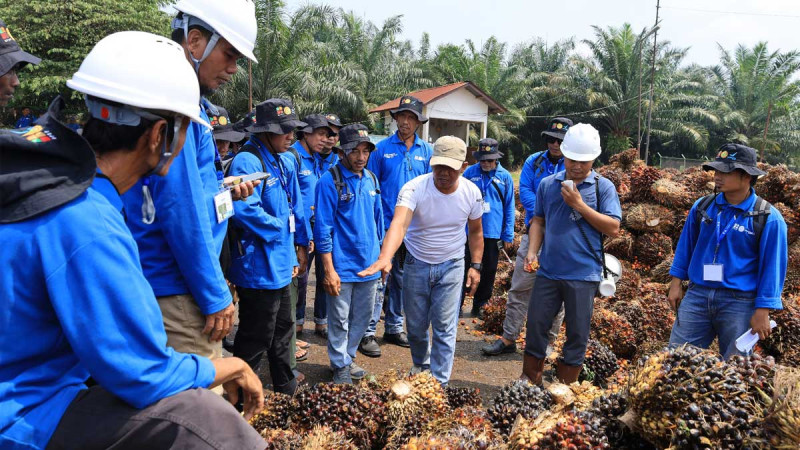
InfoSAWIT, JAKARTA – The marginal areas, that many thought to be unproductive, as a matter of fact, could deliver good harvest if they were well cultivated. Marlon Sitanggang, Head of Agronomy PT Union Sampoerna Triputra Persada (USTP) said it at Bincang-Bincang Sawit that Indonesian Planters Society (IPS) conducted and InfoSAWIT attended, Saturday (5/10/2024) in Jakarta.
Sitanggang shared his experiences when cultivating palm oil plantations that laid on about 3.740 hectares and contained of sand about more than 80%. Of the total areas, about 2.330 hectares got special treatment by applying organic fertilizers from empty bunches in the holes. Besides, PT USP did improve the areas, such as, increasing the drainage, making holes to help the trees, developing reservoirs, and enriching organic materials in the soil by planting intercrops, such as, Mocuna, empty bunches, and applying additional fertilizers, such as, sodium, phosphorus, and potassium, Boron (B), and Cuprum (Cu).
It delivered good results. “By the application, in the 2023 dry season, the company could produce fresh fruit bunch up to 26 tons per hectare,” he said.
The talk-show was attended by hundreds ofparticipants online, including the planters from many regions. This showed they were enthusiastic to the cultivation innovation in the marginal areas. In the question and answer - session, one planter that worked in Nigeria for the past seven years, was interested to the description about climate change. He requested that PT USP would conduct online training about the climate change for the planters who worked in Nigeria.
The success of PT USTP in marginal area cultivation would be the sample that with the right method, the unexpected areas could highly deliver productivity. The innovation would positively deliver not only the impacts, but new chances to cultivate palm oil plantations in the same conditions.
With the integrated approaches, the marginal areas could be optimized and delivering solution for the challenges of climate change that influenced palm oil industries. (T2)