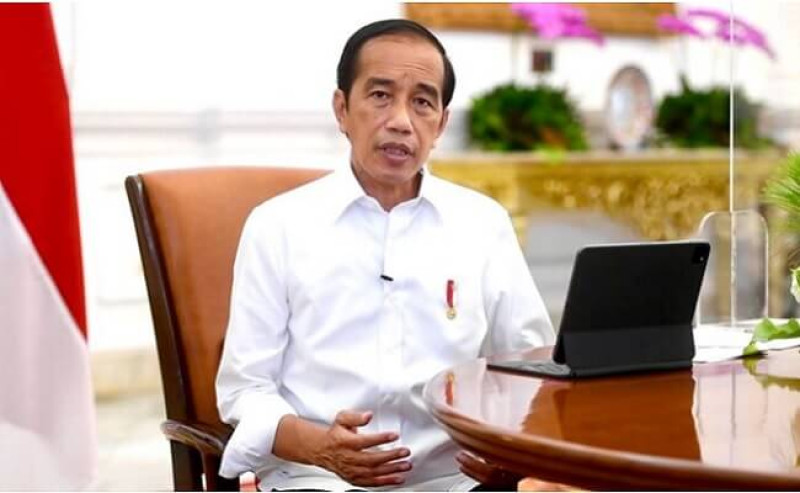
InfoSAWIT, JAKARTA – The critics from many palm oil stakeholders after President Joko Widodo (Jokowi) banned crude palm oil (CPO) and its derivative exports in April to May 2022 were heard by President Jokowi.
But he has no issue about it because the policy was about to fulfill the needs in this country.
“Many told that it was wrong. That is alright. Everyone has different opinion. I prioritize the people,” President Jokowi told in Kompas100 CEO Forum 2022, Friday, (2/12/2022).
President Jokowi banned CPO export on 28 April to May to solve the rare material to be processed as palm cooking oil in this country and to deliver decent price and to get abundant supply.
But according to Pramono Dwi Susetyo, a writer of forestry policy and once worked at Ministry of Environment and Forestry told, the very expensive palm cooking oil in this country was the effect of the increasing CPO price in the world. The government should exist to protect its citizens by intervening and making the right policy to solve the rare and expensive palm cooking oil.
Pramono thought, the policy published might have considered the risks to come including by delivering subsidy of palm cooking oil that would be sold in the society which the fund was compensated from the exchange from palm oil sectors.
“Learning from Saudi Arabia as the biggest crude oil producer in the world, though it is now more than US$ 100 per barrel, it does not mean, the fuel price in the country gets increasing because the government of Saudi Arabia fully subsidized it,” Pramono said.
Decision Making Technic
In management theory, decision making of the government to solve the rare and expensive palm cooking oil can be categorized as unprogrammed decision which normally the decision was about to solve new problems which never happened before, not repetitive, unstructured, and difficult to recognize the form, essence, and the impact.
The unprogrammed decision demands high level – idea which is combined with adaptive action, oriented to solved – problem effectiveness. Experience and observation showed that problem solving and unprogrammed - decision making would normally be non-technical.
“It means, it has nothing to do with operational but about organization policy within strategic impact for the related organization. The unprogrammed decision making in general was burdened to the managers in the top level,” Pramono noted in his late article to InfoSAWIT.
In the rare and expensive palm cooking oil – case, Minister of Trade was in charge by publishing decision about the highest retail price on bulk and packaged palm cooking oil. But it was not effective. Then the policy continued by obliging CPO producers to provide 20% of domestic market obligation (DMO) to be 30% to supply domestic needs and it was not effective either. President Joko, as the top manager in the government published one price – policy on bulk palm cooking oil which the government delivered subsidy and released economic price of packaged palm cooking oil in the markets.
The government tried as hard as it could to control and stabilize palm cooking oil price but never hit the result. Many policies were published starting from subsidized palm cooking oil, one price – palm cooking oil, and the obligation to supply DMO and olein. The policies were substituted but could not get the core of the case. CPO and olein DMO, the highest retail price of bulk and simple and premium packaged palm cooking oil which made it cheaper, were also substituted, as quoted from Kompas, (04/04/2022). (T2)